
Impact at Purnaa in 2026: Ethical, Fair Trade Manufacturing in Nepal

Updated: Jul 10

As a social enterprise and ethical manufacturer, we publish an impact report each year to reflect honestly on our journey as a Fair Trade factory in Nepal. We review what is working, where we made progress and what we still need to do.
At the heart of everything we do is our mission: creating fresh starts and fulfilled lives for marginalized people in Nepal through dignified employment.
This year’s report captures steady growth, deeper support for our team and continued learning as we try to balance people, planet and production. Read on for key highlights from 2025–2026.
The Bigger Picture: Why this work matters

In Nepal, access to stable employment is limited for many people. Each year, hundreds of thousands of Nepalis leave the country for work. Around 3.5 million people (about 14% of the population) are currently working abroad. Money sent home through remittances supports families and plays a significant role in the national economy.
Alongside labour migration, there are ongoing risks that affect the most vulnerable communities. An estimated 40,000 people are trafficked from Nepal each year, a high proportion are women and girls. Others face barriers to work and opportunity linked to caste, gender, disability or economic background.
Purnaa was set up as a Fair Trade manufacturing business in Nepal to create safe and stable employment for people who may otherwise experience barriers to work. Although employment does not solve every challenge, it can reduce vulnerability and give people more control and stability in their own lives.
A Year’s Progress: Building momentum, growth and key achievements
This year, Purnaa saw encouraging growth across multiple areas of our work and welcomed 32 new employees. On average, each Purnaa employee supports 2.5 people, meaning this growth has a ripple effect across families and communities.

We strengthened our internal capacity by expanding our admin teams in marketing, business development and product development. These hires ensure we can sustainably support our current and future customers.
For many new employees, this was their first formal job. New recruits go through an in-depth onboarding process that involves training, orientation and gradual skill development on the production floor.
As the company grows, a key focus will be to ensure that systems, training and support structures develop at the same pace as the workforce.
The Empowerment Fund continues to be a central part of Purnaa’s approach to staff wellbeing and support beyond wages. In 2025–2026, the fund supported several key areas:
33 employees received life skills training
Interest-free scooter loans doubled, supporting transport and access to work
43 school scholarships were provided for employees’ children
A new trauma healing program was introduced and supported 35 staff
These programs sit alongside support systems such as counselling services, emergency assistance and education opportunities for staff and their families.
The intention of the Empowerment Fund is to respond to practical needs that fall outside of wages, particularly in areas where financial or social barriers affect daily life.
Economic Impact: Highlights

Good wages are central to our social mission. While we are committed to paying a living wage to all staff, we acknowledge that piece rate structures mean some workers do not always reach this threshold, and our operations team has actively explored and implemented a range of approaches to address this, ensuring our commitment to fair pay is reflected in practice, not just in principle.
Each year, we follow a WFTO-aligned process to update our living wage estimate for Kathmandu. This includes reviewing a basket of essential goods, comparing local wages and alternative employment opportunities and drawing on published research. A staff-elected committee then collaboratively agrees the living wage benchmark, which becomes the lowest wage at Purnaa for the following year and the basis for all piece-rate calculations. This year, the estimated monthly cost of living for a family of four in Kathmandu is NPR 54,636 ($360 USD).
Additionally, Purnaa continued to respond to rising living costs in 2025 through salary and piece-rate reviews. Transportation allowances were also increased to better support commuting costs.
Operational improvements, including ongoing skills training and production system updates, helped us to improve workflow efficiency and reduce delays, enabling more consistent earning potential for production staff. Performance-based bonuses also continued to provide additional opportunities to increase income. Together, these changes contributed to improved income stability and overall economic wellbeing across the year.
Sustainability & Operations: Our updates

Environmental impact remains an ongoing area of focus. In 2025, Purnaa:
Doubled the amount of fabric scrap that was upcycled
Doubled the use of plant-based packaging
Continued investment in more efficient production machinery and processes
However, increased production volumes meant overall energy use also increased, particularly in cap manufacturing. Highlighting how business growth naturally leads to higher overall energy demand.
Operational improvements, including more efficient sublimation printing and upgraded equipment, helped reduce waste in many areas, although total output increased.
Water usage per employee remained significantly below industry averages, and Purnaa was completely self sufficient on water which can be attributed to our rainwater harvesting system.
Health and Wellbeing
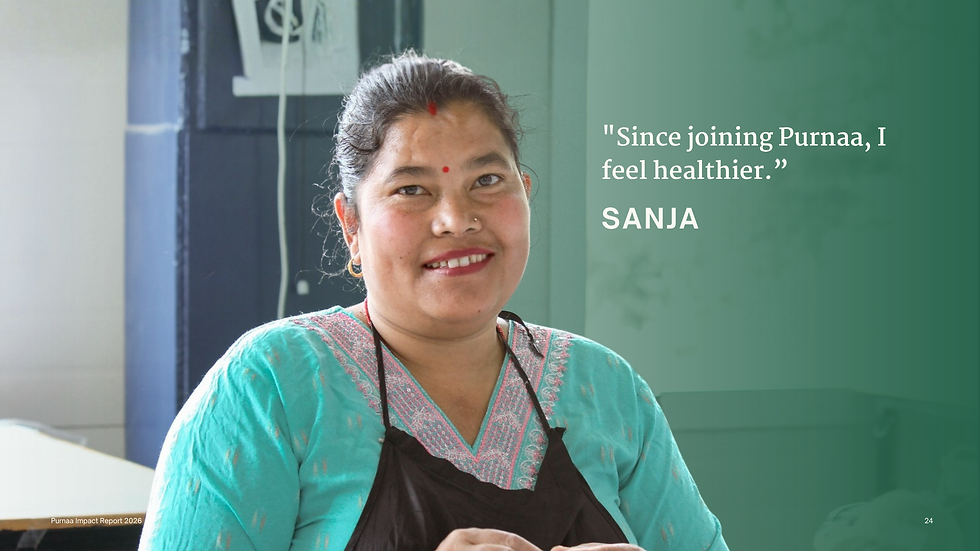
Employee health scores have shown gradual improvement over recent years. One contributing factor is access to Nepal’s Social Security Fund (SSF), which provides healthcare coverage for employees and, in some cases, their families. Helping to reduce financial pressure linked to medical treatment.
In 2025, our focus on emotional wellbeing grew. We now offer counselling services and have introduced trauma healing groups. These sessions provide a structured space for staff to reflect on personal experiences and discuss mental health in a supported environment.
The groups have been very well received, with one employee commenting;
“Before joining trauma healing, I never learned how to share my pain. Instead, I used to hurt myself and keep everything bottled up inside. Through the healing group, I learned that it is not healthy to carry pain alone. I learned how to share my struggles, how to be a good listener, and I have experienced healing from my pain.”
Feedback from our first year indicates that these spaces are being used by staff who may not previously have had access to any mental health support.
Looking to the Future: Areas for improvement

Purnaa continues to work towards strengthening our systems.
Living wage progress remains ongoing. While wages and productivity have improved overall, not all employees consistently reach a full living wage. This is influenced by global price competition and production costs. Looking ahead, we are focusing on improving efficiency and earning potential for production staff.
Sustainable packaging remains a key challenge. While internal use of biodegradable packaging has increased to 20%, a significant portion is still determined by customer requirements. One major client continues to require plastic packaging for supply chain consistency, and Purnaa is exploring options for future transition.
On-site recycling also needs further improvement. Although more material is being upcycled, some recyclable waste is still not correctly separated at source, leading to avoidable loss. Additional training and clearer systems are planned.
Looking Ahead
In the year ahead, Purnaa’s priorities include:
Creating approximately 20 additional jobs, with a focus on marginalized groups
Strengthening training systems across production and admin teams
Expanding internal career development pathways
Introducing new production capabilities, including laser cutting
Continuing improvements in environmental systems and waste reduction
A key focus is ensuring that growth is supported by internal systems, so that expansion remains stable and sustainable for staff. We will continue to increase opportunities for people from marginalized backgrounds in Nepal, including survivors of trafficking and individuals affected by discrimination related to caste, gender, disability, or economic status.
How to support Purnaa
There are a few simple ways to support Purnaa’s work as a Fair Trade manufacturer in Nepal.
Work with us!
Purnaa produces custom caps, bags, and stuffed toys, with production starting from as few as 48 pieces. Brands looking for an ethical manufacturing partner can explore our services and get in touch to learn more.
Connect us with aligned brands
We are always looking to work with companies that care about transparent supply chains and social impact, particularly those seeking an ethical cap factory or stuffed toy manufacturer.
Help share our work
Support also comes through visibility. Subscribing to our updates, sharing our blogs, and passing our content on within your network helps more people learn about ethical manufacturing in Nepal.
Want to find out more?
Check out our most recent blog posts:


