
Nepal Flash Floods 2026: How You Can Help

Updated: Sep 16

The floods in Nepal have left thousands of people in urgent need of support. If you’re looking for how to support flood relief in Nepal, or searching for official ways to donate to Nepal flood relief, this guide brings together information from trusted humanitarian organisations and practical ways to help.
On 26 August 2026, a section of glacier collapsed on Langtang Lirung, sending water, ice and debris down the valley below. Within hours, flash flooding had reached Rasuwa, Nuwakot, Dhading, Gorkha and Chitwan.
The full scale of the disaster is still being assessed, but the IFRC estimates that around 93,000 people have been affected. UN agencies report that the death toll has passed 1,300, with thousands of people still missing. UNICEF estimates that 22,000 children are without safe drinking water, while more than 10,000 school-age children need psychosocial support and a safe place to learn. At least 18 schools have been damaged across the worst-affected districts, with several destroyed completely.
Fortunately, Kathmandu was largely spared. Purnaa's factory is running, and our team is safe. But the disaster has reached into our wider community. Family members and friends of people at Purnaa are still missing, and over the past two weeks, our colleagues have been living with the uncertainty of waiting for news.
Our hearts go out to everyone affected, and especially to those who are still waiting for loved ones to return home.
What relief looks like right now
Right now, access is the immediate challenge. The floods destroyed 41 of the 63 motorable bridges along the corridor between Rasuwa and Chitwan. Rasuwa is cut off from Nuwakot, while Dhadingbesi has lost its direct link to the Prithvi Highway. Supplies that would normally arrive by truck within a few hours now have to come by helicopter, on foot, or not at all.
Crews are clearing roads so Bailey bridges (temporary steel spans that can restore access relatively quickly) can be put in place. The Nepal Red Cross Society is distributing clean water, shelter materials and first aid. UNICEF has also sent hygiene kits, jerrycans and water treatment supplies for around 19,000 people in Rasuwa and Nuwakot.
On a more hopeful note, it has been amazing to see communities coming together, donating, sorting, and giving wherever possible. We want to express our gratitude to the rescue teams who are tirelessly working to find those missing.
How can a garment factory help after a disaster?
As a garment factory, there are definitely limits as to what we can do - unfortunately we can’t rebuild a road, bridge, or a school. But in conversations and meetings about what support might be useful, we kept circulating back to the same topic: what will happen to the children affected.
For many families, recovery will not be a matter of weeks or months. Children still need somewhere to learn, routines to return to, and some sense of stability while the roads, homes and schools around them are rebuilt.
Why children need support after a disaster
A child who loses a home, a school or a family member loses their routine at the same time. Routine is a large part of how children feel safe, so when it disappears, sleep, appetite, concentration and behaviour often change in the weeks and months that follow. Younger children in particular may not have the words for what happened.
What can help is giving children opportunities to play and spend time with other children, rather than keeping them focused on what has happened. Limiting their exposure to distressing news and images can also help, especially for children who may otherwise be frightened or repeatedly reminded of the event.
They may also need an adult who will listen without rushing to reassure them or dismissing what they feel, someone who can acknowledge that being scared, angry or confused is understandable. For children who have lost a parent or caregiver, access to a trained counsellor can be especially important. UNICEF estimates that more than 10,000 school-age children in Nepal are in that situation right now.
What helps is fairly ordinary - a stable routine, a familiar adult who will listen, and time and space to process the event rather than carry it quietly. Access to a trained counsellor also makes a real difference, particularly for children who have lost a parent or caregiver. Rebuilding roads, schools, and homes could take several years, but stability for these children cannot wait that long.
How Purnaa is responding
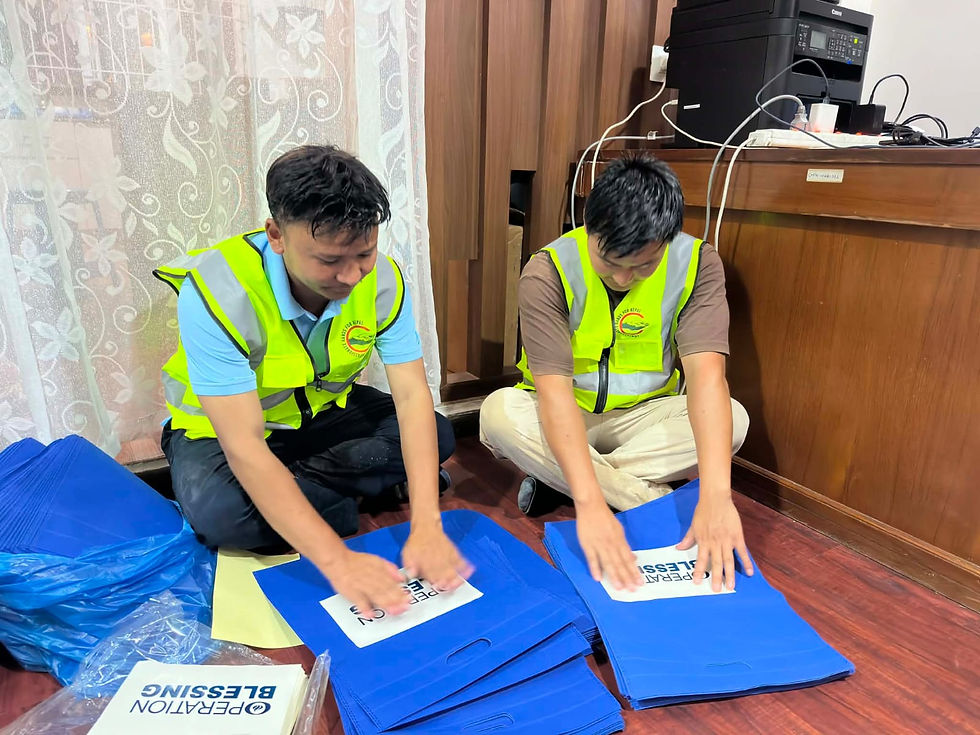
When our team asked how they could help, we wanted to make it easier for them to take action. Every Purnaa employee can take up to three days of paid leave to volunteer with an organisation of their choice. Bibek, one of our HR leads, spent his volunteer days with Compassionate Hands, helping sort donations ready for distribution.
We’re also putting our Generosity Campaign into action. Through the campaign, Purnaa matches employee donations to social causes, doubling the impact of what our team gives. This year, we’ve selected the organisation HDCS who are actively supporting flood relief efforts. Our team have also been working on designing customized trucker caps, which we will be providing through Change Action Nepal for relief workers and volunteers working on the ground (see picture below).
Supporting our community also means supporting our own people, so we’re making additional support available to Purnaa employees whose families have been affected by the floods, including counselling, loans and additional time off where needed.

Children Come First campaign
In the aftermath of a disaster, children need practical support, but they also need time and space to process what has happened. Professional mental health care is an essential part of that recovery. At the same time, we believe that a familiar and comforting toy could provide a small sense of security during a period of fear and uncertainty.
We are raising funds to help children affected by the floods access counselling and longer-term psychosocial support through Happy Minds Foundation, Purnaa’s mental health partner. Happy Minds provides counselling, therapy and psychosocial support to children and families, and has already begun offering free counselling to people affected by the floods. We will help strengthen and expand these efforts so that more people can access the support they need.
Our Children Come First campaign aims to raise enough to support one child for every $40 donated. This includes access to counselling or therapy, as well as a stuffed toy. As a guide, a $400 donation could help support around 10 children and provide approximately 25–30 hours of a qualified counsellor’s time, including travel and materials.
We have previously worked with Shadow Buddies, an organisation that creates toys for children experiencing illness or trauma. Through this work, we have seen how something as simple as a soft, familiar toy can provide comfort during times of emotional distress. As part of the campaign, Purnaa will also donate the first 100 stuffed toys, made by our team here in Nepal, to children affected by the floods.
Donations will be pooled rather than allocated to individual children. Happy Minds counsellors will travel to affected communities and, where appropriate, provide support through group sessions, which Happy Minds considers an appropriate format for children following a traumatic event.
The toys will be distributed individually to children. All figures are estimates of what donations can help fund, rather than a guarantee that a specific donation will provide a fixed amount of support to one particular child.

How you can help
Support children affected by the flood. Every $40 supports one child with a stuffed toy and access to counselling through Happy Minds Foundation.
If you are in Nepal and want to give time rather than money, several organisations are coordinating relief and can use volunteers:
Nepal Red Cross Society, running evacuation, search and rescue and emergency distribution across the affected districts, and now working on transitional shelter
HDCS who are actively providing comprehensive relief operations
Compassionate Hands, sorting and distributing donated supplies in Kathmandu
If you are outside Nepal, the Prime Minister’s fund is the most direct route for immediate relief. International appeals through UNICEF, Oxfam and the Red Cross are supporting the wider response.
The Prime Minister's Disaster Relief Fund, the government's official mechanism for rescue, relief, rehabilitation and infrastructure restoration
Purnaa recovery campaign, which is focused specifically on supporting children affected by the floods through counselling and longer-term psychosocial support.
About Purnaa
Purnaa is a fair trade manufacturer based in Kathmandu, Nepal, producing garments, caps, textile accessories and stuffed animals for brands around the world. Purnaa exists to provide dignified employment to people who have faced significant barriers to work, and to show that ethical manufacturing can meet commercial standards. Learn more about how Purnaa works at purnaa.com.
Support job creation in Nepal
Place an order with Purnaa and help create dignified, sustainable employment for people who have faced barriers to work.
Connect us with your network
Know a brand or organisation looking for an ethical manufacturing partner? Introduce them to Purnaa. Every new partnership helps us create more sustainable jobs in Nepal.


